



Graphene properties and related concepts
Dec 17,2019
Enray
Chapter Igraphene propertiesand related concepts
1 GrapheneConcept
Graphene (Graphene) is a two-dimensional crystal stripped from graphite material and composed of carbon atoms with only one layer of atomic thickness. Graphene narrowly refers to a single layer of graphite with a thickness of 0.335nm and only one layer of carbon atoms. But in fact, the graphite structure within 10 layers can also be called graphene, and more than 10 layers are called graphite films. Single-layer graphene refers to graphite with a thickness of only one carbon atom layer, and carbon atoms-carbon atoms are connected by covalent bonds to form a honeycomb structure. Perfect graphene has an ideal two-dimensional crystal structure, composed of a hexagonal lattice, and a theoretical specific surface area of up to 2.6 × 10²m2/g. Graphene has excellent thermal conductivity (3 × 10³W/(m • K)) and mechanical properties (1.06 × 10³GPa). In addition, the stable regular hexagonal lattice structure of graphene makes it have excellent conductivity, and the electron mobility at room temperature is as high as 1.5 × 104 cm2 / (V · s). Graphene's special structure, outstanding thermal and electrical conductivity and mechanical properties have aroused great interest in the scientific community and become a hot research topic in materials science.

Graphene structure diagram
2graphene structure
Graphene refers to a single layer of graphite that is only one atomic-scale thick and consistssp2 hybrid carbon atoms closely arranged into a honeycomb crystal structure. The carbon-carbon bond length in graphene is about 0.142nm. Within each lattice there are threeσ bondThe connection is very firm to form a stable six-sided shape. in the direction perpendicular to the crystal planeπThe bond plays a big role in the process of graphene conduction. Graphene is the basic unit of graphite, carbon nanotubes, and fullerenes. It can be regarded as an infinite aromatic molecule. The limit of planar polycyclic hydrocarbons is graphene.
Graphene is composed of a single layer of carbon atoms tightly packed into a two-dimensional honeycomb lattice structure, which looks like a plane composed of a hexagonal grid. In single-layer graphene, each carbon atom passes throughsp2 hybridization forms a bond with the surrounding carbon atoms to give a rectifying deformation. each hexagonal unit is actually similar to a benzene ring, and the carbon atoms contribute an unbonded electron. The thickness of single-layer graphene is only 0.35nm, which is about one-twentieth of the diameter of the hair.
The structure of graphene is very stable, the connection between carbon atoms and its flexibility. When subjected to external force, the carbon atom surface will be bent and deformed, so that the carbon atoms do not have to be rearranged to adapt to the external force, thereby ensuring its own structural stability.
Graphene is a finite structure that can exist in the form of nano-scale stripes. The lateral movement of the charge in the nanoribbon produces an energy barrier near the neutral point, and the barrier increases with the decrease of the band width. Therefore, the desired barrier can be further obtained by controlling the width of the graphene strip. This property is the basis for the development of graphene-based electronic devices.
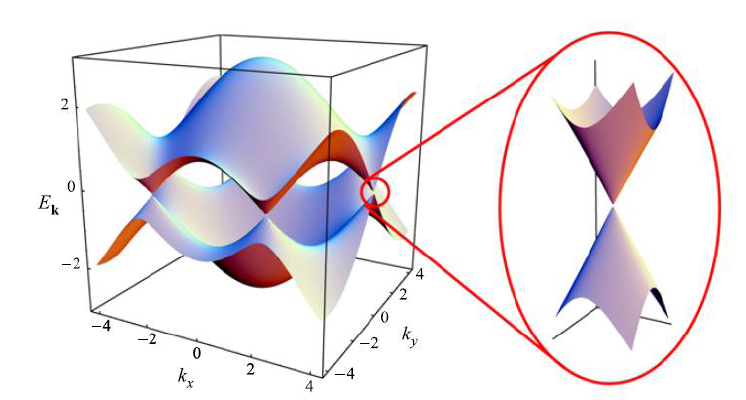
Graphene energy band structure diagram
3graphene properties
Graphene is an ultra-light material with an areal density0.77mg/m2The main properties are: One is a super conductive. The electron mobility of graphene is higher than that of carbon nanotubes or silicon crystals, which is100 times, can reach 15 000cm at room temperature2/( V·s). The resistivity is much lower than that of aluminum, copper and silver, only 10~6Ω·About cm. Two is a super thermal conductivity. The thermal conductivity of graphene is better than that of carbon nanotubes, which is 10 times that of copper, aluminum and other metals, and the thermal conductivity is as high as 5300 W/m • K. Third, it has super mechanics, the hardness of graphene exceeds diamond, and the fracture strength reaches 100 times that of steel. Four is a super light transmission. The absorption rate of graphene is very small, and the light transmittance is as high as 97. 7%. Five is a super surface area. The specific surface area of graphene per gram is 1130m higher than that of ordinary activated carbon2, reach2630m2 /g。
3.1Optical properties of graphene
GrapheneIt is the thinnest and hardest nanomaterial known in the world. It is almost completely transparent and only absorbs2.3 percent of the light.,Has excellent optical properties. Theoretical and experimental results show that monolayer graphene absorbs2.3%of visible light, I .e., the transmittance is97.7%. The visible light transmittance from the substrate to the single-layer graphene and the double-layer graphene are different in sequence.2.3%Therefore, the number of layers can be estimated according to the visible light transmittance of the graphene film. Combined non-interacting Dirac-The fermion theory, which simulates the transmittance of graphene, yields results that are consistent with experimental data.
According to the principle of refraction and interference, graphene with different layers will show different colors and contrast under the optical microscope, which provides convenience for the identification of graphene layers.
Theoretical and experimental results show that large-area graphene films also have excellent optical properties, and their optical properties vary with the thickness of graphene. Graphene film is a typical transparent conductive film, which can replace indium tin oxide (ITO), fluorine-doped indium oxide (FTO) and other traditional film materials, which can overcomeITOThe brittleness of the film can also solve many problems such as the limitation of the application of scarce indium resources. Graphene transparent conductive films can be used as window layer electrodes for dye-sensitized solar cells and liquid crystal devices.
In addition, when the intensity of incident light exceeds a certain threshold, the absorption of graphene will reach saturation. This nonlinear optical behavior is known as saturable absorption. In the near infrared spectral region, under strong light irradiation, due to its wide band absorption and zero band gap characteristics, graphene will slowly approach the saturation absorption. Using this property, graphene can be used for ultra-fast photonics, such as fiber lasers.
3.2Electrical properties of graphene
Each carbon atom of graphene issp2hybrid, and contribute to the remaining oneporbital electron formationπkey,πElectrons can move freely, giving graphene excellent electrical conductivity. Because the force between atoms is very strong, at room temperature, even if the surrounding carbon atoms collide, the interference of electrons in graphene is very small. Electron transmission in graphene is not easy to scatter, transmission efficiency1.5×105cm2/( V·s),Aboutfor electron mobility in silicon140Times. Its conductivity can reach106s/m, while the resistivity is only about 10-6ΩCm, lower than copper or silver, is the smallest resistivity material in the world. Because of its extremely low resistivity and extremely fast electron migration, it is expected to be used to develop a new generation of electronic components or transistors with thinner and faster conductivity. Because graphene is essentially a transparent and good conductor, it is also suitable for making transparent touch screens, light panels, and even solar cells.
The emergence of graphene has stirred up huge waves in the scientific community. It has been found that graphene has extraordinary electrical conductivity, dozens of times higher than steel and excellent light transmission. Its appearance is expected to trigger a revolution in the field of modern electronic technology. In graphene, electrons can migrate extremely efficiently, while traditional semiconductors and conductors such as silicon and copper perform far less well than graphene. Due to the collision of electrons and atoms, traditional semiconductors and conductors release some energy in the form of heat,In 2013, the average computer chip wasted 72%-81% of its electricity in this way, while graphene is different, its electronic energy will not be lost, which makes it have extraordinary excellent characteristics.
Mechanical Properties of Graphene 3.3
Graphene is the crystal structure with the highest strength and hardness among materials. Its tensile strength and elastic modulus are respectively125GPaand1.1TPa. The strength limit of graphene is42N/m2. The strength of ideal graphene is about the strength of ordinary steel.100times, with an area1m2The graphene layer can withstand4kgThe quality. Graphene can be used as a typical two-dimensional reinforcement material and has potential application value in the field of composite materials.
3.4Thermal Properties of Graphene
The strength of graphene is harder than diamond, and it can maintain its original form at high temperatures. From this point, it shocked the physical world, mainly because the arrangement of carbon atoms in graphene is regular and regular. When an external force is applied to graphene, the internal carbon atoms will not be displaced, but only bent and deformed, which can resist the external force and ensure their stability.
The room temperature thermal conductivity of graphene is the thermal conductivity of copper at room temperature.10More than twice, high thermal conductivity5300 W/m • K, higher than carbon nanotubes and diamond. The theoretical specific surface area of graphene can reach2630m2/g, the micro sensor supported by graphene can sense a single atom or molecule. When the gas is attached to or detached from the surface of graphene, the adsorbed molecule changes the local carrier concentration of graphene, resulting in a step change in resistance. This feature can be used to make gas sensors. Theoretical calculations show that graphene and lithium can form a porous composite structure with strong hydrogen storage capacity.
3.5Magnetic Properties of Graphene
Graphene is often ferromagnetic after hydrogenation, mainly because graphene has lone pairs of electrons at the edge after hydrogenation, which makes graphene magnetic. The researchers also have done by changing the temperature in the presence of a magnetic field to see if the magnetism of graphene can be changed. Determine the magnetic field strength1T, when the temperature T<90K, graphene will show paramagnetic properties; when the temperature T>90K, graphene will show a diamagnetic properties.
Chemical properties of 3.6 graphene
The electronic properties of graphene have received widespread attention, but the chemical properties of graphene have been neglected. What we only know about the chemical properties of graphene so far is that graphene can adsorb the surrounding atoms and molecules in an orderly manner (for example, nitrogen dioxide, ammonia, potassium), which is somewhat similar to the activated carbon we know. Nitrogen dioxide, ammonia, and potassium are often used as donors or acceptors, causing the concentration of carbon atoms inside graphene to change, but graphene itself is a conductive material. Other adsorbates, such as hydrogen ions and hydroxide ions, produce derivatives with poor conductivity, but these are not new compounds, just graphene decorating different adsorbates. Since graphene and graphite are allotropes of carbon, from a chemical point of view, they often have some of the same properties, so in some areas where graphene is not familiar, graphite can be used to carry out corresponding experiments to find The law of graphene, with this relatively simple and convenient idea, in the future, more chemical properties of graphene will be excavated.
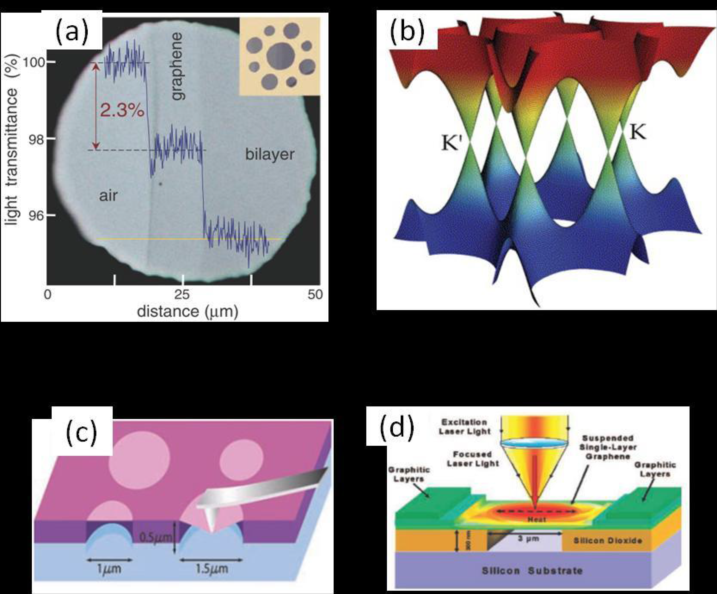
Schematic diagram of the optical, electrical, mechanical and thermal properties of graphene
Next article
Related News